Amazon Elastic Container Registry
Standing by category
| Category | Function | Share | Rank | Negative rate | Labels | Quadrant | Since September 2026 |
|---|---|---|---|---|---|---|---|
| Artifact and container registries | Developer platform | 10% | 3 of 89 | 0% | 15 | accepted challenger |
Movement
By model
How each model treated Amazon Elastic Container Registry across every prompt where it was named for a mid-market B2B company. Fourteen models, six prompts per category.ShowHide
By model
| Model | First choice | Alternative | Mention | Negative | Labels |
|---|---|---|---|---|---|
| Claude Haiku 4.5 | 0 | 0 | 0 | 0 | 0 |
| GPT-5.4 mini | 0 | 0 | 0 | 0 | 0 |
| Gemini 3.5 Flash | 1 | 1 | 0 | 0 | 2 |
| Perplexity Sonar | 0 | 0 | 0 | 0 | 0 |
| Grok 4.1 Fast | 0 | 0 | 0 | 0 | 0 |
| Mistral Small | 1 | 1 | 0 | 0 | 2 |
| DeepSeek V4 Flash | 1 | 0 | 0 | 0 | 1 |
| Llama 4 Maverick | 1 | 0 | 0 | 0 | 1 |
| Qwen 3.7 Flash | 2 | 0 | 1 | 0 | 3 |
| Kimi K2 | 1 | 0 | 1 | 0 | 2 |
| GLM 4.7 FlashX | 0 | 0 | 0 | 0 | 0 |
| MiniMax M2.5 | 0 | 1 | 0 | 0 | 1 |
| GPT-6 Luna | 0 | 1 | 0 | 0 | 1 |
| Muse Glimmer 30B | 0 | 1 | 1 | 0 | 2 |
By framing
What the models said for it
Verbatim evidence the judge attached to positive labels.
“2. Amazon Elastic Container Registry (ECR) - a fully-managed Docker container registry that makes it easy for developers to store, manage, and deploy Docker container images.” Llama 4 Maverick · Artifact registries · paraphrase prompt · first choice
“For most mid-sized B2B companies, Amazon ECR is the top recommendation due to its scalability, security, and AWS ecosystem integration.” Mistral Small · Artifact registries · paraphrase prompt · first choice
“For 90% of mid-sized B2B companies, Amazon ECR or Google Artifact Registry is the safest, most secure, and most scalable bet.” Gemini 3.5 Flash · Artifact registries · paraphrase prompt · first choice
“Tier 1 (Trusted): Enterprise Private Registries (AWS ECR, Google GCR/AAR, Azure ACR) configured with RBAC and Scanning.” Qwen 3.7 Flash · Artifact registries · negative prompt · first choice
And against it
Verbatim evidence attached to negative labels. A warning on a product with few labels is a warning; on a product with many, it is one voice among them.
Named alongside
The products named in the same answers as Amazon Elastic Container Registry, over the 34 answers that named it. Took the first choice instead counts the answers where the other product was the first choice and Amazon Elastic Container Registry was named but was not.ShowHide
Named alongside


What carried it into the answer
Citations exist only for the models that return a source list, five of the fourteen in this edition, so these counts come from 29 of the 34 answers that named Amazon Elastic Container Registry and are not a share of its labels.
Domains cited
Ninety-six of the ninety-six domain citations in answers naming Amazon Elastic Container Registry came from somebody else's page.
Pages cited
Pages are listed as the models cited them.
Search and answers
Where Amazon Elastic Container Registry stands in Google search beside where it stands in the models' answers.ShowHide
Search and answers
In search
Google, US estimates- Searches for its name, Google
- 1,300 a month (“amazon elastic container registry”)
- AI search demand for its name, est.
- 0 a month
- Its own site
- It sits on Amazon's site (amazon.com), so there are no site figures for it alone
In answers
This edition- First choices
- 9 across its categories
- Named in
- 34 answers
- Its own site cited
- in 29 of the answers that named it
Search figures are US estimates from DataForSEO, read October 5, 2026; AI search demand is its modeled, directional estimate, not a count of queries to any assistant. The answers are this edition's. Two measurements side by side: neither is read as the cause of the other.
Names read as Amazon Elastic Container Registry
Follow Amazon Elastic Container Registry
An email the morning each edition publishes: where this product moved, where it held, and by how much against the noise floor. One address, confirmed by a click; a stop link in every email.
Already following? Everything you follow, with a stop for each.
The company
Amazon is the company behind Amazon Elastic Container Registry.ShowHide
The company
On record
Company records- Also from Amazon
- Amazon API Gateway, Amazon API Gateway HTTP APIs, Amazon AppStream 2.0, Amazon Athena, Amazon Athena Federated Query, Amazon Aurora, Amazon Aurora Serverless, Amazon Bedrock and 46 more
Claim this page
Claiming is free and changes nothing in the data. A claimed page shows a verified contact who is told when each edition publishes and when Amazon Elastic Container Registry's standing changes by more than the noise floor; the right to propose corrections to the vendor table, meaning names the judge wrote that should or should not read as Amazon Elastic Container Registry, applied by version and listed in the change log; and a one-line description supplied by the vendor and marked as such.
What a new claim receivesHide what a new claim receives
A new claim receives the current edition's vendor brief for Amazon Elastic Container Registry by email, built from the raw record of the edition. It shows:
- where Amazon Elastic Container Registry is named, by buyer and by framing, and which cells hold its first choices;
- the claims the models make when they name it, ranked, with the strongest and the weakest quoted;
- its vocabulary against the segment leader's, and the pages the models cited;
- who was chosen in the answers that did not name Amazon Elastic Container Registry, and every reason the record gives;
- a battlecard for each top rival: the head-to-head split, why they win, and the reservation quoted against them;
- one page of published figures cleared to show a buyer.
Badges
Wins only: a badge exists where Amazon Elastic Container Registry is ranked in a category's top three this edition. Three sizes, one file each, light and dark; the code is under each.ShowHide
Badges
Amazon Elastic Container Registry is among the products AI models recommend first in Artifact and container registries this edition. Each badge says so in the buyer's words, names the edition, and links to the standing. The next edition issues a new badge; this one stays true as a record of October 2026.

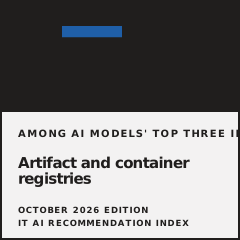

Badges read on light and dark pages. Alt text carries the claim, the category, the edition and the index, so it stays a citation where the image does not load.